del.icio.us links
dgen's Last.fm

Creative Commons License

home :: work :: projects :: blog  :: people

2007-08-28 (Tue)

Jodrell Bank, 50 years on …

August 28th, 2007 by Gavin

4.jpg

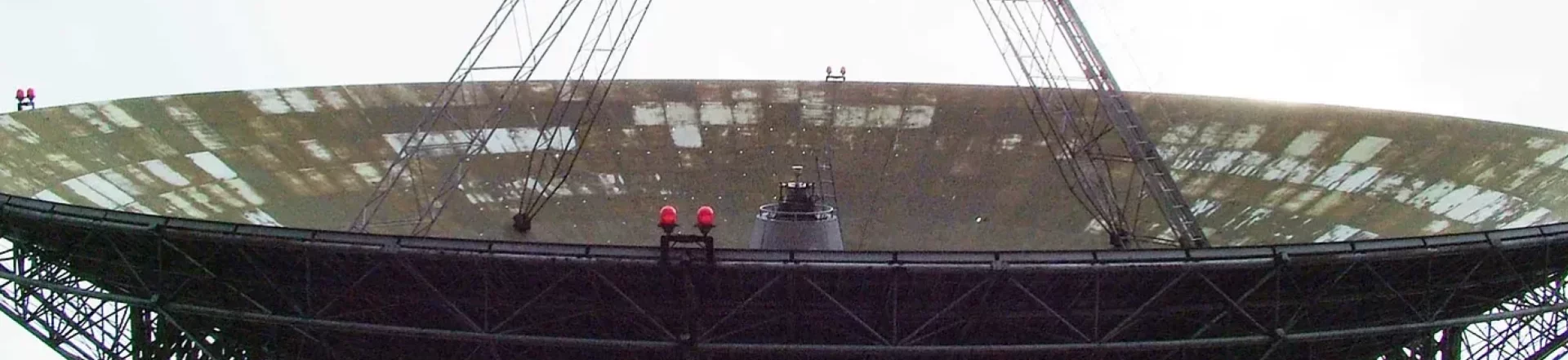
This year is the 50th anniversary of Jodrell Bank.

Today is also a landmark day for Jodrell Bank – the whole science team are moving from on-site, to Manchester University. While this is probably very practical, I can’t help feeling sad that this unique and historic research establishment is dramatically shifting its identity.

I worked at Jodrell from 1994-1995 and thoroughly enjoyed it: 120 scientists in the middle of a field in deepest Cheshire. Remarkably “British” Science – on my first day I was shown around to one of the “workshops” (very slightly more advanced than a garden shed) where someone was building an amplifier for the main dish and cooling it to about 10 degrees Kelvin, making it one of the quietest amplifiers on Earth. In another room, someone was building their own data router, to carry data at 30 Gigabits per second,

3.jpg

since the best commercial ones of the time couldn’t come anywhere close

…today MERLIN’s seven telescopes ship 30Gbps, each, to a huge computer cluster at the main facility that processes 150-200Gbps of data in real time – making it one of the most powerful computers on Earth.

2.jpg

The history of Jodrell Bank and the Lovell Telescope is vast: it’s first official task was to identify and track Sputnik – it was the only instrument the West had (at the time) that could do so.

1.jpg

Pulsars and Quasars are amongst the discoveries in which Jodrell was the catalyst. The Cosmic Microwave Background, Masers, Gravitational Lenses, and myriad others are part of the rich mixture of Radio Astronomy research.

[youtube=http://www.youtube.com/watch?v=wtFdKNzQky0]

Jodrell gets very little mention compared to other facilities, unlike its US counterpart the VLA, or the Hubble Space Telescope. The latter is particularly relevant – Jodrell has had equal or better resolution than the HST since before HST launched – and the only reason you don’t know that is because NASA have a $20m “marketing budget” to tell the world. That’s about the same as Jodrell had to upgrade the entire facility.

Jodrell was mentioned a couple of times in The Hitchhiker’s Guide to the Galaxy “… Jodrell Bank looked straight through them [Vogon spacecraft]— which was a pity because it was exactly the sort of thing they’d been looking for all these years … someone decided it was time for a nice relaxing cup of tea” – and happens to be very true: tea at 11am and 3pm was an unmissable part of the day. Everything stopped. It was at tea that one of the longest serving members of staff was trying to recall how they’d built some of the 6-bit computers I was trying to re-interpret the data from (”now was bit 3 the weather or the telescope ID?”). I should have kept that envelope…

Last year the Lovell Telescope was nominated the UK’s greatest ‘Unsung Landmark’ in a BBC competition. This only scratches the surface. To me, Jodrell Bank is iconic of an entire country of passionate, brilliant scientists, who get little of no recognition for the spectacular work that they do. At various times, Jodrell has had to justify its existence, which is reasonable for any institution to have to do, but I believe that much of its real value is overlooked….

5.jpg

I am delighted that, 13 years after leaving, I will be going back to hear some of my music played at the 50th Anniversary celebrations. Amongst other things they are projecting onto the 76m Lovell dish, which should be quite spectacular – it’s at least twice the size of the largest IMAX screen. (hope the weather’s good!).

2007-08-19 (Sun)

Sea ice – lowest ever measured

August 19th, 2007 by Gavin

On 17th Aug 2007, Arctic sea ice surpassed the previous single-day (absolute minimum) record for the lowest extent ever measured by satellite. NSIDC is now tracking changes on at least a weekly basis…

Arctic sea ice - average
(Source: NSIDC.org)

The following images represent the change quite profoundly.

Arctic sea ice - Sep 15, 1979

Arctic sea ice - Aug 9, 2007
(source: RealClimate)

2007-08-12 (Sun)

BBC iPlayer – strategic errors

August 12th, 2007 by Gavin

I’ve now had a chance to download, try and then, unfortunately un-install the BBC iPlayer.

There’s already a lot of commentary about the use of Windows Media DRM so I won’t labour the cross-platform issues (anyway, the use of DRM is never actually about technology – if it worked, and if it was really easy, it still wouldn’t help)

I think there are deeper strategic errors.

One significant issue is that while the BBC used to lead (and sometimes still leads), the world has moved on amazingly quickly – leaving the iPlayer standing in a very lonely and strange place.

The worlds of broadcast, community and accessibility no longer really have boundaries. We already have an age where TV is built around community (e.g. YouTube, etc) and is instantly international (e.g. Joost, etc).

In the UK it’s already stupidly easy to do time-shifting with PVRs (e.g. MythTV and any £30 USB DTV stick) and on the other side of the pond, some crazy startups are being valued at $1bn before they even have a name, let alone a website.

iPlayer focuses on  something that’s trivial to do with existing tech, and that tech doesn’t try to “constrain” the content and has better video quality.
iPlayer doesn’t feel enabling.  It doesn’t connect me with anyone, it doesn’t even show signs of linking back into the BBC site/rest of the internet.  It doesn’t feel interesting as a website, as a “channel” or an “aggregator”. It feels like some of the prototypes we built in 2000, which might have been interesting at the time, but not now.

What might be better? A player we could embed in our own sites (geo-restriction is still possible, time-expiry is still possible, branding is still possible). Probably Flash for now. Then Dirac.  Then see what people build. It wouldn’t be hard.

I shudder to think that if the £ that must have gone into iPlayer had gone into Dirac, where might we be…?

2007-08-5 (Sun)

Energy consumption debunktion

August 5th, 2007 by Gavin

Kind of what you’d expect from the Media, but it’s still saddening to see.

http://www.timesonline.co.uk/tol/news/uk/science/article2195538.ece

.. it’s like much of the climate change backlash and genuine general confusion: “let’s just say it’s all greenwash, let’s debunk everything, find the flaws, but at all costs avoid the presentation of any actual solutions. And Heaven forbid that we mention what’s actually going on”.

But I love some of the reader comments… “The problem we have is there are too many miserable middle and old aged people who aren’t dead”. He has a point there. There are a few more commentators who call for genocide as the most practical solutions – the trouble is that this is actually likely to happen if we just keep on the way we have been (e.g. if 500 million people run out of water, you get wars).

Anyway, here’s some real data that relates to the article;

1. They assume 0.188 kgCO2/km, which is the medium petrol car figure in AMEE, and is not valid for a single short trip.

2. If you weren’t going to the shop, you would presumably be doing something that did involve moving muscles – breathing for example. Thus your personal CO2 emissions from *existing* are not really part of this calculation. Driving doesn’t make you somehow exist less.

3. The meat/dairy argument is comparing apples with cheeseburgers..

Everyone (especially the whole of the media) needs to work an awful lot harder to present what is a genuinely complex issue, and one that strikes at the fabric of how we’ve chosen to live. It’s way beyond just “Climate Change”. It’s no surprise we’re all finding it hard, but it’s very hard to have an informed debate when no one seems the least bit interested in what’s actually going on or spending the time to learn about the details.

There are two choices, neither of which actually have anything to do with your “belief” in climate change.

Choice A is so eloquently put in one of the reader comments, I can only quote it;

Choice A) “Racing motorcycles, BASE jumping and hot-footing it from one brothel to another whilst high on a cocktail of drugs, drink and junk food until one or more of the aforementioned results in a youthful but exhilarating death.”

Choice B is my preferred view on the world.

Choice B) Use less energy. Enable scale and thus access to better technology to more people. Reduce our own levels of consumption by being vastly more efficient. Avoid Mass Extinction Events by being less stupid (albeit that we do not have a good track record on that last point).

Corollary: Choice (B) doesn’t preclude anyone from doing (A). In fact you might be able to do (A) for longer. However, (A) tends to preclude (B) and therefore ruins it for the rest of us.