del.icio.us links
dgen's Last.fm

Creative Commons License

home :: work :: projects :: blog  :: people

2009-05-27 (Wed)

Δten / Δ10 / delta10

May 27th, 2009 by Gavin

Many late night discussions over the last year from FOWA, IT@Cork, eTech, Green:net to Geekyoto, and with the AMEE team have led me to think on topics like

  • “digital inheritance”
    (e.g. what if you could inherit your grandfather’s iPod?)
  • dematerialisation
    (digital products and products transforming into services)
  • desiring what we need
    (as opposed to the consumer movement that drove us from a needs-based culture to a desire-based culture)
  • modelling flow rather than inflation
  • and change and adaptation in an elastic society
    (to redefine the notion of “growth”)

Far, far too much to try and summarise here, but hopefully good springboards for discussion. A recurring theme is the transformation from products to services  (eg. the instant car rental schemes where you can rent for 30 mins). Digital music has already dematerialised the physical product of music to replace CDs.

Inspired by the powers of ten, I’ve been wondering how in the world might make the 90% reduction in CO2/GHGs that’s required to address climate change. This is an order-of-magnitude change in the way we currently live.

We need to all make “powers of ten” changes to our lives, from the CO2 intensity of our power production, to the way we relate to products and services.

So, to my latest call to action…

“Turn every product into a service for 10 people”

I’ve christened this Δten / Δ10 / Delta Ten, so it can be talked about in those management consulting meetings where (Six Sigma) is mentioned.

In fact, maybe Delta Ten should be an add-on to Six Sigma?

“Delta Ten seeks to improve the sustainability of process outputs by identifying and removing the causes of inefficiencies (errors) and variation in manufacturing and business processes, and extends this to usage patterns (e.g. resource sharing and re-use), consumption and waste, by using strong reductionist techniques to diminish the use of energy and materials by a factor of ten.”

  • delta 1 = 10% efficiency increase (10% reduction in materials, increase in energy efficiency, or energy consumption through re-use)
  • delta 9 = 90% efficiency increase (90% reduction in materials, increase in energy efficiency, or energy consumption through re-use)
  • delta 10 = The process is rendered wholly and demonstrably sustainable through the effective and credible management of resources (e.g. renewable energy, managed forestry, effective waste management, and cradle-to-cradle/biomimetics).

A delta 10 means you have created an environmentally-intelligent service, not a product.

Anyone like to help?

2009-05-8 (Fri)

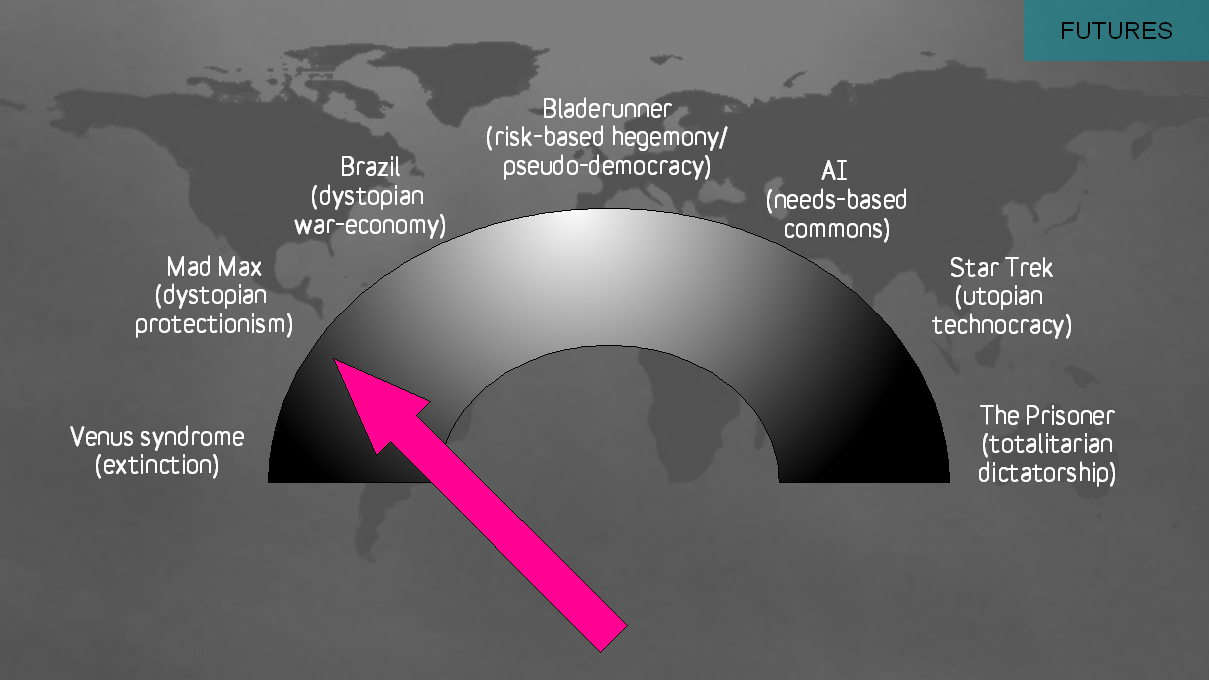
Possible futures?

May 8th, 2009 by Gavin

A better voting version of this


Online Surveys & Market Research

2008-11-28 (Fri)

The Climate Change Act

November 28th, 2008 by Gavin

Below are some highlights from a great summary on the 2degrees site (which requires registration and I’d recommend if you want to get involved).

I’m just back from IT@Cork  where amongst many things I learned that Ireland has one of the most advanced electricity grids in the world – they’re very close to being able to execute Demand Response which, if implemented at scale (internationally), would have a massive impact on energy management, efficiency and reduction. The UK Act will help move this agenda (and others) forward not just in the UK, but internationally.

Credit: Allen Shaw

“The Climate Change Act 2008 is a historic piece of legislation. It is the first of its kind anywhere in the world and, if successful, a model likely to be replicated in other jurisdictions.

A key element of the legislation is the provision for the carbon reduction commitment which this network is all about understanding – and includes the statutory powers to, for instance, develop UK centred carbon trading to fulfil the obligations within the CRC

… the scale up in the deployment of renewables is extremely aggressive and presents significant investment opportunities.

One of the most valuable features of the new Act is the greater certainty on strategy provided by the requirement to specify three five year carbon budgets that will be legally binding and scrutinized by a powerful Climate Change Committee. As the Minister of State for the Environment, Phil Woolas stated:

“The Bill establishes legally binding long-term targets and medium-term budgets to provide greater clarity for UK industry, and that will enable businesses to plan effectively and invest in the technology that is required to move towards a low-carbon economy and to reap the potential economic benefits that are on offer. It will ensure that we adapt to unavoidable climate change as well.”

The Act in more detail:

The Climate Change Act focuses on a number of policy areas:

  • Energy efficiency with the Carbon Reduction Commitment (CRC) as flagship policy
  • Renewables expansion (increased ten fold by 2020)
  • Transport policy
  • Low carbon technology
  • Zero carbon buildings
  • Public awareness and mobilization
  • Adaptation

The calendar of activities is:

  • 1 December, 2008 the new Climate Change Committee (CCC) delivers advice for the first three carbon budgets.
  • 2009 budget first three carbon budgets delivered.
  • Mid 2009 detailed proposals presented on carbon budgets.
  • September 2009 Climate Change Committee annual report.
  • January 2010 government publishes first response to CCC report.

Key features include:

  • 80% reduction in carbon emissions by 2050 (26% reduction by 2020).
  • All primary greenhouse gases to be included (check)
  • A carbon reduction commitment on businesses with half hourly metered consumption > 6,000MWh / year with support for emissions trading
  • Provision for inclusion of aviation and international shipping in climate policy.
  • Restrictions (amounts still to be determined) on the amount of carbon reductions that can be met by credits earned overseas.
  • A Climate Change Committee convened and empowered to advise, scrutinize and report – and hold the government to account.
  • Five year carbon budgets to be published three periods at a time – these are legally binding on government.
  • Government to report at least five yearly on the degree to which the UK is at risk from climate change.
  • Statutory powers to require public bodies and utilities to take action on adaptation.

Other powers bundled with the legislation:

  • Provision to enforce charging for single use carrier bags
  • Provision for variable charging of domestic waste
  • Amendments to the Renewable Transport Fuels Obligation

2008-10-26 (Sun)

Virtual conferencing at HEAD conference

October 26th, 2008 by Gavin

HEAD conference

I presented at <head> at the London Hub (in person) on Friday, and today online (from home). I wanted to capture some of my thoughts immediately before I forget:

This is the first time I believe I’ve seen what I’d call true p2p broadcasting.  Perhaps a coming of age.

Having spent (too) many years webcasting everything from Glastonbury to conferences to Parliament, I have to say that this went very well. I started doing “webcast chats” at Virgin Net in 1996, which worked – and helped me learn how to mash up broadcasting with chat rooms – but the video was still “one-way”. The distributed-source nature of HEAD really changed this context.

As a presenter, I found the experience relatively seamless*. The great benefits of presenting from home included;

- not having to travel the venue, hang around, and travel back.

This is a vast benefit. It’s very low stress, even travelling across London is stressful. No (/minimal) missing out on family time at weekends.

- No CO2 footprint.

- No £cost.

The negative bits? Missing out on serendipity.  This was mitigated, in part, by the Hubs – which is a great idea – and the chat room. It actually felt a bit more human than standing on a stage.

I enjoyed this more than most conferences I’ve spoken at, and had more (and better) questions via the chat room. I also felt much more comfortable stopping “presenting” and actually listening to the questions. Maybe physical conferences should present the back-channel to the presenter on their tele-prompt?

The distributed nature of the presenters coming into the video stream really helped to create a feel of community. Being able to jump between rooms was also very handy.

Things that would make it better;

1) As a presenter, being able to see and/or hear the viewers; somehow. I’m not sure how. More emoticons, a “sucks more/less” slider? This would really help with gauging feedback. Put pressure on your presenters to be better – this can only be a good thing.

2) As both audience and presenter – a cross-room chat back-channel. I’d love to see the chatter from other presentations to see if there were points of serendipity I could pull out (while presenting). As an audience member I’d like to see all the chats.

3) Better software* integration to manage my view vs everyone else’s view and how it can be customised.

4) Presenter’s need to be retrained – this will take time. Aral made a training video, which was great, but we need to extend this to a whole new “stage” (e.g. getting good lighting, decent cams, etc.). I hooked up 2 webcams so I could jump-cut but manage it well while speaking – but I have a motorised cam, so could have given position control to the audience.

In summary, this was a great experience (especially for a first conference) and one I’d definitely repeat.

I also estimate that this approach saved between 1,000 and 5,000 tonnes of CO2.

Well done to Aral and the whole HEAD team.

*Adobe still have a huge amount of work to do to get it right (there were some pretty basic features missing from the online app).

2008-09-25 (Thu)

Cape Farewell

September 25th, 2008 by Gavin

Cape Farewell

Cape Farewell sets off today with a slightly different crew to norml; including Jarvis Cocker, KT Tunstall, Laurie Anderson, Ryuichi Sakamoto and many other remarkable individuals.

Hopefully I’ll have something more to write about soon, but in the mean time, good luck Chris and no I’m not jealous at all…

2008-09-21 (Sun)

Sea ice – update (sept 2008)

September 21st, 2008 by Gavin

Sea ice - (Sept 2008)

(source: http://nsidc.org/arcticseaicenews/)

The Arctic sea ice cover appears to have reached its minimum extent for the year, the second-lowest extent recorded since the dawn of the satellite era. While slightly above the record-low minimum set in 2007, this season further reinforces the strong negative trend in summertime sea ice extent observed over the past thirty years.

NSIDC will issue a formal press release at the beginning of October with full analysis of the possible causes behind this year’s low ice conditions, particularly interesting aspects of the melt season, the set up going into the winter growth season ahead, and graphics comparing this year to the long-term record.

2008-08-4 (Mon)

Can’t everyone define the future?

August 4th, 2008 by Gavin

At least once a year I refer someone I meet to Danny’s superb piece on Wired UK.

I wanted to write about this now, partly because I’m embarking on a new venture, partly because there is a another bubble emerging, but mostly because I’m reminded of the “global coincidence of desires” that Danny spotted in 1994.

An amazing part of what Danny captured was what it felt like at that time: the genuine, emotive belief by an army of people that they could change the world (and many did), and how at a time when the nature of a website was something we were all trying to work out – that individual decisions fundamentally affected the architecture and building blocks that shape what we do now. Aside from the gold-rush, the underlying story of world-changing actions.

I was fortunate enough to work with Tony, Danny and Rik at Virgin Net.

I was in my mid-20s. I was an Astrophysicist and knew a bit about software. I had my own naive views of how the web might bring about the democratisation of information – both through bottom-up action and by redirecting mass-media – I had more than a little to learn.

I certainly wasn’t Wired. My move to London was enough of a culture shock – I remember my first meeting about “online community” – listening to Marketing define it as “everyone inside the M25″, me trying to describe the 800 person village on a small Scottish Island I grew up in, Tony describing Colours Magazine and Danny talking about the real things people were doing. I don’t think any of us actually understood each other.

I spent most of my 4 years at Virgin listening, watching, experimenting and learning how a coincidence of desires is impossible to execute – even within relatively small, exceptionally talented and committed team inside an international brand. Over the last 9 years I’ve learned a bit more about multi-dimensional communication; and the many impossible balances between corporate, social and personal objectives.

This global coincidence of desires is fueling collisions across all our spaces (”convergence” is never anything but a collision). The catalyst is our looming potential self-destruction – our “Resource Crisis” now encapsulates Climate Change and Peak Oil, Energy, Water and Landfill shortages, the depletion of raw materials, globalisation, the list goes on…

Each year I re-read Danny’s “What nearly happened” to remind myself how that time felt, and to re-contextualise one of the most important statements in it, a point that Tony made: “can’t everyone define the future?”.

Apart from great insights backed by luck, I’m not sure anyone understood how the web would really manifest itself today, and how long it would take. I spent at least 5 years attempting to get a YouTube-like idea off the ground, but the serendipity wasn’t fully aligned until 2 years after I stopped trying.

At ETech this year, Tom Loosemore summarised MySociety’s 5 step process for changing civil society, which includes “Leave for X years”.

Now we’re in a space where we are starting to seriously address the combination of cloud, grid and edge, open APIs, open data, openID and oAuth – watching the unfurling of everybody, unpacking system that “dump excess energy in the form of structure” [Burke] and scratching the surfaces of digital identity management.

All these are arriving, coincidentally, at exactly the time we need them – not just in a technological sense, but driven by a global consciousness that we all know: that, really, we need to do this to address sustainable living.

Friends who’ve been pushing the environmental agenda for decades have a tough time right now, having everyone else come in an “own” their parade, but mass-adoption rarely recognises the small army of dedicated individuals who created the movement. It’s a painful transition but we need them all to help us work out what’s next even if it is “move all the towns“.

The fascinating thing for me is watching the whole sustainability space not only collide with itself, but with a broader, globally connected consciousness, driven by a Resource Crisis that will affect every living thing.

The personal desire to catalyse change has been evident in every single person I’ve met over the last 3 years, from politicians to scientists, from bands to hedge funds, from engineers to activists: “everybody”.

Our challenge lies in creative execution: to create many granular, networked spaces that can flourish. How can we let these networks flourish and not only create value for them, but redefine what value means in the process? The words are coming: “Creative Capitalism“, “Philalthrocapitalism” but you have to assume that these are the sticking-plasters of change, similar to the early old-media references to the Net, rather than the radical re-engineering that’s needed. That re-engineering will, most likely, come from unexpected places.

2008-07-20 (Sun)

The Great Global Warming Swindle swindle

July 20th, 2008 by Gavin

Further to the outcry at the time, this weekend The Guardian reports;

“Channel 4 to be censured over controversial climate film”

“Channel 4 misrepresented some of the world’s leading climate scientists … Ofcom is expected to censure the network … but … it did not breach the regulator’s broadcasting code and did not materially mislead viewers.”

I’m certainly looking forward to reading how it’s possible to misrepresent the world’s leading climate scientists without misleading viewers.

The key quote seems to be “One source said both sides would be able to claim victory after a bitter dispute” which sounds like diplomacy has won over decisiveness and truth.

2008-06-3 (Tue)

Food, population, climate, trade

June 3rd, 2008 by Gavin

As the UN sets out its food crisis measures, and setting aside the climate change, population growth and other globalisation issues, this image caught my attention

Food price impact on Trade Balances

and made me wonder, what colour *should* it be to start actually balancing trade “balances”.

One very naive photoshop crayon trip later, I coloured in a different perspective.

Food price impact on Trade Balances

I wonder what the outcomes would be…

2008-04-16 (Wed)

Sea ice – how well is it recovering?

April 16th, 2008 by Gavin

We’re losing 44,000 square kilometers (17,000 square miles) of ice per year in winter (March-to-March).

Last year, we watched the lowest ever sea ice measurement unfold. It wasn’t happy viewing. Here’s the graph just after the low point – as of October 16, the extent was 3.20 million square kilometers (1.23 million square miles) below the long-term average.

Sea ice - lowest ever measured (oct 2007)

(source: http://nsidc.org/)

If we now look at winter, when the ice is reforming you can see what looks like good recovery, but note that the solid black line is the average and the dotted line the previous record low… so it’s still bad.

Sea ice - lowest ever measured (apr 2008)

“While the March 2008 maximum was 780,000 square kilometers (301,000 square miles) greater than the past record low, set in March 2006, it was 540,000 square kilometers (208,000 square miles) less than the 1979 to 2000 mean and occurred later in the year. Including 2008, the linear trend for March indicates that the Arctic is losing an average of 44,000 square kilometers (17,000 square miles) of ice per year in March. Although March 2008 extent is greater than in recent years, the setup looks right for another dramatic ice loss this summer.” [emphasis mine]

These images and graphs should be part of the weather forecast every day on every TV and Radio channel.

Next Page �